
 Wine Advisor



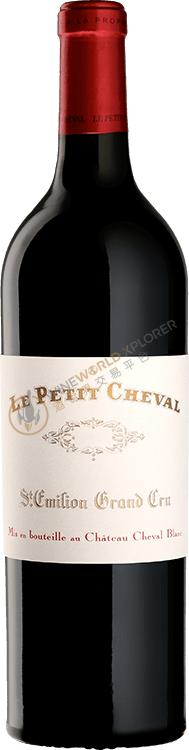
Le Petit Cheval 2016
 View analysis


Description
Tasting notes

Reviewed by: Antonio Galloni
The 2016 Petit Cheval is gorgeous. Soft and silky, with polished tannins, the Petit Cheval is a wine of pure and total grace. Sweet red cherry fruit, tobacco, cedar, licorice and leather are all gently pushed forward. Soft contours and an air of refinement add to the wine's sheer appeal.
Reviewed by: Antonio Galloni
The 2016 Petit Cheval is gorgeous. Translucent, expressive and finely-knit, the 2016 captures the gracious side of the estate and vintage beautifully. The 2016 tilts heavily to Merlot in the blend, but it is the brighness of the Franc that drives the wine. In 2016, the Petit Cheval is a wine of precision and freshness above all else.
Reviewed by: Neal Martin
The 2016 Le Petit Cheval has a strange nose at first, with more heightened lavender/potpourri scents than expected. With time, more red fruit, hickory and light autumn leaf aromas emerge. The palate is medium-bodied with slightly dry tannins. This is quite savory in style, indicating some Cabernet Franc (38% of the blend). A little chewy toward the finish, and I am not sure it has the longevity of its peers. Tasted blind at the annual Southwold tasting.
Reviewed by: Neal Martin
The 2016 Le Petit Cheval comes from just three, sandier parcels and continues the estate’s policy of blending as much of the entire vineyard into the Grand Vin as possible without compromising quality. It has a generous black cherry, boysenberry and fig-scented bouquet with light cedar aromas courtesy of the Cabernet Franc. The medium-bodied palate delivers supple tannin and a crisp line of acidity. I appreciate the freshness here, the linearity and approachability, and the subtle graphite tincture toward the finish. Quite elegant in style. Drink this over the next decade.
Reviewed by: Lisa Perrotti-Brown
The 2016 Le Petit Cheval is composed of 62% Merlot and 38% Cabernet Franc. Medium garnet-purple colored, it has a knock-out nose featuring beautiful red rose, black tea, unsmoked cigars, menthol and yeast extract scents with a core of black cherries, kirsch and warm plums plus a waft of dusty soil. Medium-bodied, tightly wound and wonderfully perfumed in the mouth, the palate features loads of vibrant, pristine pure fruit and a beautifully soft texture, finishing very long.
Reviewed by: Neal Martin
The 2016 Le Petit Cheval is a blend of 62% Merlot and 38% Cabernet Franc from three parcels, representing 7% of the total production. Matured in 60% new oak, it has an attractive bouquet with raspberry preserve, pressed flowers and a touch of orange rind. The palate is medium-bodied with fine delineation and poise, a fine prickle of acidity, maybe a tad tight having just been wrenched from barrel but with fine salinity on the finish. Be advised to give this three or four years in bottle just to smooth out that slight rigidity on the finish.
Reviewed by: Neal Martin
The 2016 Le Petit Cheval comes from just three, sandier parcels and continues the estate’s policy of blending as much of the entire vineyard into the Grand Vin as possible without compromising quality. It has a generous black cherry, boysenberry and fig-scented bouquet with light cedar aromas courtesy of the Cabernet Franc. The medium-bodied palate delivers supple tannin and a crisp line of acidity. I appreciate the freshness here, the linearity and approachability, and the subtle graphite tincture toward the finish. Quite elegant in style. Drink this over the next decade.
Reviewed by: James Suckling
This is a red with pinpoint but also beautiful tannin, fruit and acid focus. Medium to full body and a tight center palate. Creamy texture. Really excellent. Best second wine of Cheval Blanc in years.
Reviewed by: James Suckling
This is so polished with extra-fine tannins. Love the licorice and raspberries and the complex, stony aromas and flavors. It builds slowly on the palate and then continues for minutes. A wonderful second wine of Cheval Blanc. Try from 2023.
About the Producer
This wine comes from the Saint-Emilion region on the right bank of Bordeaux, France. It is worth mentioning that, in view of the excellent quality and uniformity of the grapes, Château Cheval Blanc did not brew the second-brand wine in 2015. Except for a small part of wine for internal use that is not for sale, the remaining grapes are all used for wine production. Brew the real wine. The winery implements a rigorous and meticulous brewing process to minimize the use of chemicals to produce fresh, elegant, delicate and balanced wines. After the grapes are crushed, they are placed in small tanks with a capacity of 450 kg, after which the must flows into the fermenters by gravity flow (Gravity Flow). Depending on the weight of the must after crushing and the plot of origin, the winemaker will choose a different fermenter and only fill 3/4 of it. After 12 hours of alcoholic fermentation, the workers perform skinning three times a day. According to the daily tasting by the technical team and the cellar supervisor and the measurement data of the liquid hydrometer, the workers will gradually reduce the number of skins in the late fermentation period. After the alcoholic fermentation is complete, the wine is soaked in the skins for several days in temperature-controlled fermenters at 28-30°C to make the tannins more supple and the structure smoother. Afterwards, the wine liquid is transferred to a fermenter at 20°C for 3 weeks to several months of malolactic fermentation (Malolactic Fermentation) to soften the acidity and stabilize the structure. After all the fermentation processes are completed, the wine is transferred to new oak barrels and aged in an underground cellar with a constant temperature of 14°C for 16-18 months. The winemaker will change barrels at this stage, using inert gas to transfer the 210 liters of wine to adjacent oak barrels to minimize oxidation and maintain the balance of the wine. After aging in barrels for three months, the winemaker tastes the wine in each oak barrel, and then mixes the wine to prepare the current year's Cheval Blanc red wine.
1996(1)1999(1)2000(1)2001(1)2002(1)2003(3)2005(3)2007(2)2008(2)2009(3)2010(2)2011(7)2012(4)2013(2)2014(4)
Package Size
12 x 75cl
