
 Wine Advisor



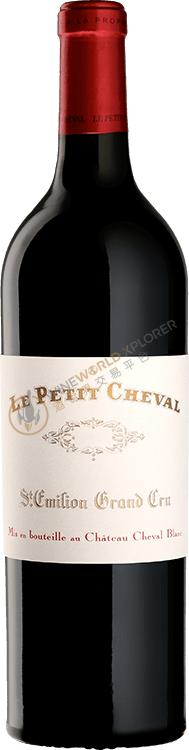
Le Petit Cheval 2000
 View analysis


Description
Tasting notes

Reviewed by: Neal Martin
A deep garnet hue. The nose is reticent at first, but then a lovely bouquet of blackberry, blueberry and crushed violets emerges and gains intensity with aeration. Fine tannins on the palate, cohesive but still quite backward with a surprisingly firm backbone and an austere finish. Needs more time. Tasted October 2007
Reviewed by: Robert M. Parker, Jr.
For those not lucky or rich enough to purchase the 2000 Cheval Blanc, there is an alternative ... the 2000 Le Petit Cheval. This offering has often been an afterthought, but the 2000 possesses some of its bigger sibling's character. A blend of equal parts Merlot and Cabernet Franc (40% of the production made it into this wine), it does not have the mass or depth of the Cheval, but this exceptional effort offers sweet, concentrated, plush flavors, wonderful opulence, and lovely density. This beauty will be drinkable upon release, and will last for 12-15 years. Believe it or not, the 2000 Le Petit Cheval is better than some vintages of Cheval Blanc have been over the last two decades.
Reviewed by: Robert M. Parker, Jr.
The fully mature 2000 Le Petit Cheval reveals some herbal notes interwoven with sweet red currants. Medium-bodied with lots of spice and menthol, the wine tails off in the mouth. It needs to be drunk up.
Reviewed by: Robert M. Parker, Jr.
The 2000 Le Petit Cheval has often been an afterthought. A blend of equal parts Merlot and Cabernet Franc (40% of the production made it into this wine), this exceptional effort offers sweet, concentrated, plush flavors, wonderful opulence, and super density. This beauty will be drinkable upon release, and will last for 12-15 years.
About the Producer
This wine comes from the Saint-Emilion region on the right bank of Bordeaux, France. It is worth mentioning that, in view of the excellent quality and uniformity of the grapes, Château Cheval Blanc did not brew the second-brand wine in 2015. Except for a small part of wine for internal use that is not for sale, the remaining grapes are all used for wine production. Brew the real wine. The winery implements a rigorous and meticulous brewing process to minimize the use of chemicals to produce fresh, elegant, delicate and balanced wines. After the grapes are crushed, they are placed in small tanks with a capacity of 450 kg, after which the must flows into the fermenters by gravity flow (Gravity Flow). Depending on the weight of the must after crushing and the plot of origin, the winemaker will choose a different fermenter and only fill 3/4 of it. After 12 hours of alcoholic fermentation, the workers perform skinning three times a day. According to the daily tasting by the technical team and the cellar supervisor and the measurement data of the liquid hydrometer, the workers will gradually reduce the number of skins in the late fermentation period. After the alcoholic fermentation is complete, the wine is soaked in the skins for several days in temperature-controlled fermenters at 28-30°C to make the tannins more supple and the structure smoother. Afterwards, the wine liquid is transferred to a fermenter at 20°C for 3 weeks to several months of malolactic fermentation (Malolactic Fermentation) to soften the acidity and stabilize the structure. After all the fermentation processes are completed, the wine is transferred to new oak barrels and aged in an underground cellar with a constant temperature of 14°C for 16-18 months. The winemaker will change barrels at this stage, using inert gas to transfer the 210 liters of wine to adjacent oak barrels to minimize oxidation and maintain the balance of the wine. After aging in barrels for three months, the winemaker tastes the wine in each oak barrel, and then mixes the wine to prepare the current year's Cheval Blanc red wine.
