
 Wine Advisor



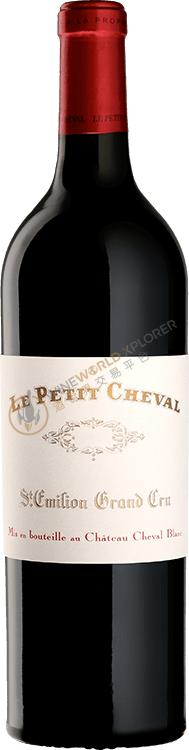
Le Petit Cheval 2021
 View analysis


Description
Tasting notes

Reviewed by: William Kelley
Representing 13% of the estate's production (a further 18% was sold off in bulk), the 2021 Le Petit Cheval exhibits aromas of cherries, sweet berries, loamy soil, tobacco leaf and spices. Medium to full-bodied, lively and nicely concentrated, with powdery tannins and a saline finish, it's a blend of 60% Merlot, 33% Cabernet Sauvignon and 7% Cabernet Franc.
Reviewed by: Neal Martin
The 2021 Le Petit Cheval (Blanc) is 80% aged in foudres and 20% in demi-muids, 80% Sauvignon Blanc and 20% Sémillon. It has a well-defined bouquet, fresh and vibrant, displaying Anjou pear and touches of Granny Smith, petrichor scents surfacing with aeration. The palate is well-balanced with a lovely texture, the Sémillon playing a greater influence than the proportion of the blend would suggest and imparting a slightly waxy texture. Fleeting touches of chamomile and quince emerge toward the finish. Excellent.
Reviewed by: Antonio Galloni
The 2021 Le Petit Cheval has held on to that strict, almost Médoc-like nose engendered by the higher proportion of Cabernet Sauvignon (33%): blackberry, briar, incense and graphite, the latter more pronounced than at en primeur. The palate is medium-bodied with a clean and precise entry, fresh acidity, refreshing sapidity and an almost briny finish that lingers in the mouth.
Reviewed by: William Kelley
As readers may remember, this cuvée simply represents everything that doesn't synergize with Cheval Blanc's blend, so the 2021 Le Petit Cheval is composed of some 60% Merlot, 7% Cabernet Franc and 33% Cabernet Sauvignon, amounting to fully half the surface planted to Cabernet Sauvignon at Cheval Blanc. Offering up aromas of dark berries, mulberries and mint framed by creamy new oak, it's medium to full-bodied, fleshy and polished, concluding with a long, delicately vanillin-inflected finish. Its composition means that it will reward a bit of patience.
Reviewed by: James Suckling
This is a very structured Petit Cheval, because of the higher than normal cabernet sauvignon in the blend. It seems more like Pauillac, with blackcurrants and chewy yet polished and intense tannins. It needs time. 60% merlot, 33% cabernet sauvignon and 7% cabernet franc.
Reviewed by: James Suckling
This is an unusually cabernet-based Petit Cheval with blackcurrant and mineral character and hints of seashell. Medium-bodied, with punchy tannins but a polished and beautiful texture. Tight at the end. Impressive and structured. It’s very St. Julien for this second wine. 60% merlot, 33% cabernet sauvignon and 7% cabernet franc. Best after 2027.
About the Producer
This wine comes from the Saint-Emilion region on the right bank of Bordeaux, France. It is worth mentioning that, in view of the excellent quality and uniformity of the grapes, Château Cheval Blanc did not brew the second-brand wine in 2015. Except for a small part of wine for internal use that is not for sale, the remaining grapes are all used for wine production. Brew the real wine. The winery implements a rigorous and meticulous brewing process to minimize the use of chemicals to produce fresh, elegant, delicate and balanced wines. After the grapes are crushed, they are placed in small tanks with a capacity of 450 kg, after which the must flows into the fermenters by gravity flow (Gravity Flow). Depending on the weight of the must after crushing and the plot of origin, the winemaker will choose a different fermenter and only fill 3/4 of it. After 12 hours of alcoholic fermentation, the workers perform skinning three times a day. According to the daily tasting by the technical team and the cellar supervisor and the measurement data of the liquid hydrometer, the workers will gradually reduce the number of skins in the late fermentation period. After the alcoholic fermentation is complete, the wine is soaked in the skins for several days in temperature-controlled fermenters at 28-30°C to make the tannins more supple and the structure smoother. Afterwards, the wine liquid is transferred to a fermenter at 20°C for 3 weeks to several months of malolactic fermentation (Malolactic Fermentation) to soften the acidity and stabilize the structure. After all the fermentation processes are completed, the wine is transferred to new oak barrels and aged in an underground cellar with a constant temperature of 14°C for 16-18 months. The winemaker will change barrels at this stage, using inert gas to transfer the 210 liters of wine to adjacent oak barrels to minimize oxidation and maintain the balance of the wine. After aging in barrels for three months, the winemaker tastes the wine in each oak barrel, and then mixes the wine to prepare the current year's Cheval Blanc red wine.
1996(1)1999(1)2000(1)2001(1)2002(1)2003(3)2005(3)2007(2)2008(2)2009(3)2010(2)2011(7)2012(4)2013(2)2014(4)2016(4)2018(5)2019(6)2020(9)
Package Size
