
 Wine Advisor



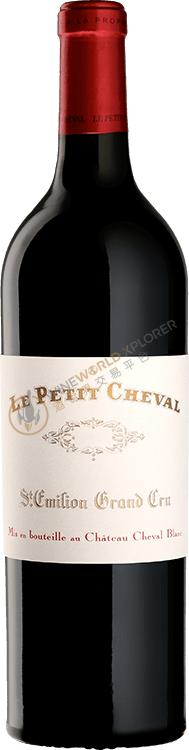
Le Petit Cheval 2018
 View analysis


Description
Tasting notes

Reviewed by: Lisa Perrotti-Brown
A blend of 70% Merlot and 30% Cabernet Franc, the medium to deep garnet-purple colored 2018 Le Petit Cheval rocks up with open-knit notes of crushed black raspberries, plum preserves and mulberries, plus hints of wild mushrooms, pencil lead, mossy tree bark and cloves. The medium to full-bodied palate is plush, juicy and pretty much ready for business, featuring plenty of earth and black fruit layers, finishing long with a spicy kick. Ten percent of the total production this year went into this second label of Cheval Blanc. I'd give it just another year or two in bottle to fan its tail out a little more and then drink it over the next 15-18 years.
Reviewed by: Lisa Perrotti-Brown
“This year, this is truly a baby Cheval, right in line with the grand vin,” commented Technical Director Pierre-Olivier Couet. Ten percent of the total production this year went into this second label of Cheval Blanc. Composed of 70% Merlot and 30% Cabernet Franc, the medium to deep garnet-purple colored 2018 Le Petit Cheval needs a lot of coaxing to encourage subtle nuances of crushed rocks, fallen leaves, potpourri and fertile loam to emerge before giving way to fragrant notes of warm blueberries, black raspberries, kirsch and unsmoked cigars with a touch of Marmite toast. Medium to full-bodied, the palate delivers layers of fresh, crunchy black fruits and loads of earthy sparks, framed by soft, velvety tannins and just enough freshness, finishing long.
Reviewed by: Antonio Galloni
The 2018 Petit Cheval is a rich, heady wine. The natural intensity of the year comes through loud and clear in the wine's super-ripe profile and voluptuous feel. Black cherry, tobacco, new leather, licorice and menthol saturate the palate. When I tasted it from barrel I thought the Petit Cheval would drink well upon release, but I suggested cellaring for a few years. There's a lot here.
Reviewed by: Antonio Galloni
The 2018 Petit Cheval represents 10% of the estate's production and is taken from a collection of five parcels that span all of the three main soil types of the property: sand, gravel and clay, all of which were, incidentally, in the Grand Vin in 2016. A wine of remarkable harmony and class, the 2018 Petit Cheval possesses striking textural depth and nuance. Succulent black cherry, mocha, grilled herb, licorice and menthol build in a voluptuous, racy Petit Cheval that will drink well right out of the gate. The blend is 70% Merlot and 30% Cabernet Franc.
Reviewed by: Neal Martin
The 2018 Le Petit Cheval has a pretty bouquet that demands some coaxing from the glass (indeed, I left the bottle a couple of hours to fully open). Blackberry and bilberry fruit, tobacco and light autumn leaf aromas gently unfold but never slip into fifth gear. The palate is medium-bodied with a leafy, slightly herbaceous entry that I personally like, though others seeking more fruit intensity might find it a little lean. But it is fresh and harmonious, and very classic in style, with residues of tobacco and bell pepper on the aftertaste.
Reviewed by: Neal Martin
The 2018 Le Petit Cheval comes from the usual five parcels representing the diverse soils across the estate. It has a tightly wound bouquet with blackberry, blueberry, cedar and light iris petal notes, broody at the moment but opening with aeration. The palate is medium-bodied and very pliant with pure black fruit mixed with light truffle and tobacco notes. Harmonious with a precise finish that feels a tad compact at the moment. Therefore, give bottles three to four years once this is released, which it will be (unlike the previous vintage!)
Reviewed by: Neal Martin
The 2018 Le Petit Cheval comes from the usual five parcels representing the diverse soils across the estate. It has a tightly wound bouquet with blackberry, blueberry, cedar and light iris petal notes, broody at the moment but opening with aeration. The palate is medium-bodied and very pliant with pure black fruit mixed with light truffle and tobacco notes. Harmonious with a precise finish that feels a tad compact at the moment. Therefore, give bottles three to four years once this is released, which it will be (unlike the previous vintage!)
Reviewed by: James Suckling
This shows beautiful density of fruit, but the tannins arrive at the end and show impressive length and density. Full body. Wild fruit. Excellent second wine from Cheval.
Reviewed by: James Suckling
Beautiful aromas of bark, dried mushroom, berry and tile follow through to a full body with richness of fruit, creamy and ripe tannins and a flavorful finish. Needs two or three years to come around. Try after 2024.
About the Producer
This wine comes from the Saint-Emilion region on the right bank of Bordeaux, France. It is worth mentioning that, in view of the excellent quality and uniformity of the grapes, Château Cheval Blanc did not brew the second-brand wine in 2015. Except for a small part of wine for internal use that is not for sale, the remaining grapes are all used for wine production. Brew the real wine. The winery implements a rigorous and meticulous brewing process to minimize the use of chemicals to produce fresh, elegant, delicate and balanced wines. After the grapes are crushed, they are placed in small tanks with a capacity of 450 kg, after which the must flows into the fermenters by gravity flow (Gravity Flow). Depending on the weight of the must after crushing and the plot of origin, the winemaker will choose a different fermenter and only fill 3/4 of it. After 12 hours of alcoholic fermentation, the workers perform skinning three times a day. According to the daily tasting by the technical team and the cellar supervisor and the measurement data of the liquid hydrometer, the workers will gradually reduce the number of skins in the late fermentation period. After the alcoholic fermentation is complete, the wine is soaked in the skins for several days in temperature-controlled fermenters at 28-30°C to make the tannins more supple and the structure smoother. Afterwards, the wine liquid is transferred to a fermenter at 20°C for 3 weeks to several months of malolactic fermentation (Malolactic Fermentation) to soften the acidity and stabilize the structure. After all the fermentation processes are completed, the wine is transferred to new oak barrels and aged in an underground cellar with a constant temperature of 14°C for 16-18 months. The winemaker will change barrels at this stage, using inert gas to transfer the 210 liters of wine to adjacent oak barrels to minimize oxidation and maintain the balance of the wine. After aging in barrels for three months, the winemaker tastes the wine in each oak barrel, and then mixes the wine to prepare the current year's Cheval Blanc red wine.
