
 Wine Advisor



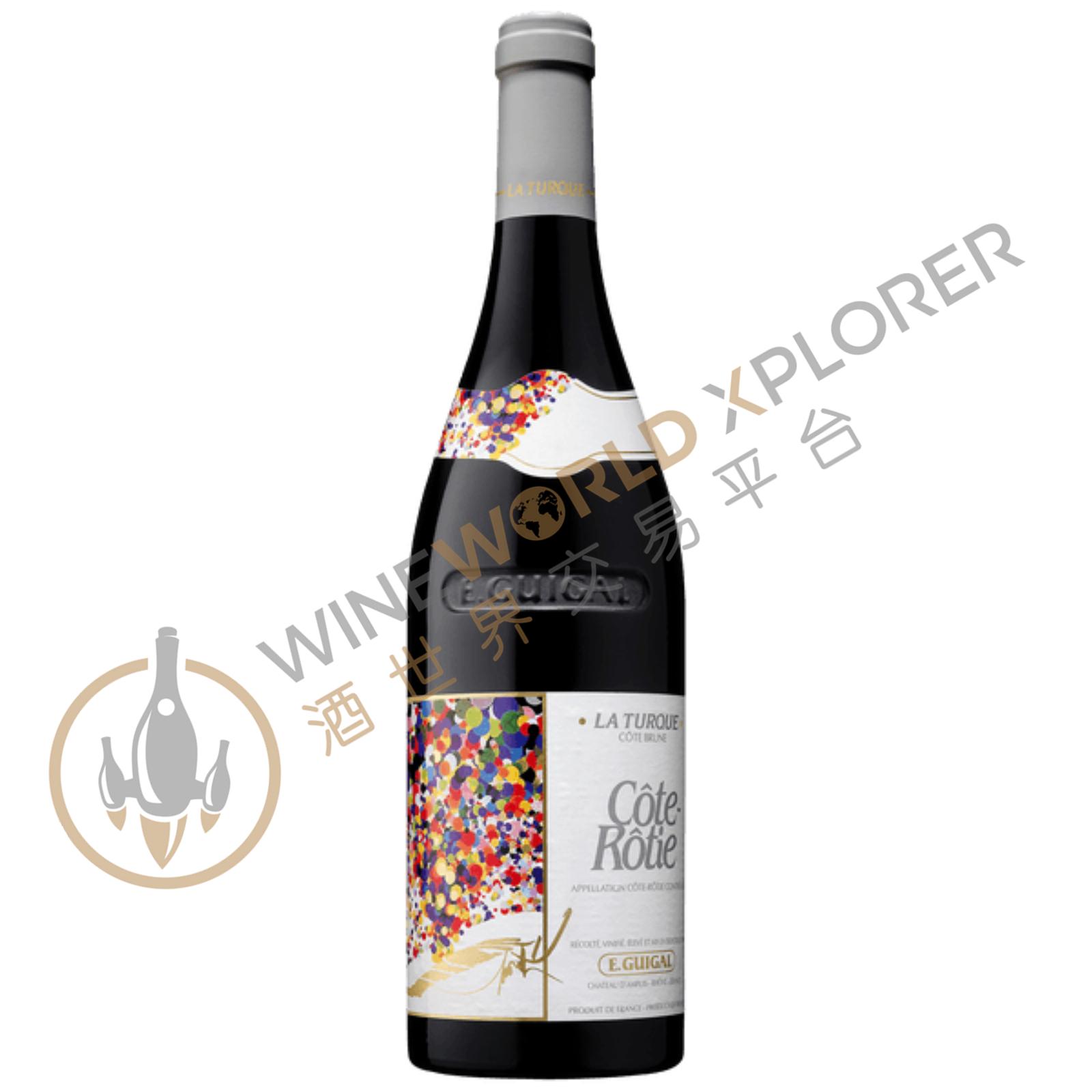
Etienne Guigal, Cote Rotie La Turque 2007
 View analysis


Description
Côte-Rôtie "La Turque" is one of the flagship of the Domaine GUIGAL. A powerful wine with spicy notes, its terroirs from côte brune with “blond accents” lends it a great elegance.
Tasting notes

Reviewed by: Josh Raynolds
Opaque ruby. Dark berries, cherry-cola, licorice and Indian spices on the pungent nose. Deeply pitched blackberry and floral and licorice pastille flavors brighten with air and show an intense spicy quality, along with a touch of mocha. Clings tenaciously on the finish, which strongly repeats the cherry and licorice notes. In a more brooding style than the Mouline and years away from maturity.
Reviewed by: Josh Raynolds
Inky ruby. A sexy, intensely perfumed bouquet displays cherry compote, black raspberry, cola, potpourri and singed orange. Juicy, focused and spicy, offering red and dark berry flavors and a touch of smokiness. A bitter licorice note lingers on the strikingly long, sappy, yet refreshingly brisk finish.
Reviewed by: Josh Raynolds
Bright purple-red color. Intensely floral bouquet displays spicy red berries, violet, rose and minerals, with a touch of singed orange lending an exotic character. Livelier and more feminine than the Mouline today, with tangy red berry and cherry flavors and a late note of candied flowers. The spicy note comes back on the finish, which is impressively fresh and incisive.
Reviewed by: Jeb Dunnuck
The 2007 Cote Rotie la Turque is an elegant, seamless example of this cuvee that offers sensational notes of smoked meats, truffles, blackberries and cassis, as well as a hint of tapenade with time in the glass. It has a rich, unctuous and full-bodied profile on the palate, with sweet, sweet tannin and an utterly seamless texture that makes it go down way too easy. Drink this beauty anytime over the coming two decades or more.
Reviewed by: Robert M. Parker, Jr.
The 2007 Cote Rotie La Turque’s inky/blue/purple color is followed by aromas of asphalt, charcoal, graphite, barbecue smoke, roasted meats/aged beef, blackberries, cassis and violets. With huge body, massive concentration, silky tannins, sweet glycerin and a layered, multidimensional mouthfeel, it can be drunk now or cellared for 25 years. The following paragraph is taken from issue #193, but I believe it is so important to understand the Guigal philosophy that I am repeating it verbatim. “As I have written many times before, no one in the wine world is better at ‘raising’ a wine (or as the French call it elevage) than Marcel Guigal, who learned the skills from his father, Etienne. Because everyone tends to focus on vintage conditions and terroir, the importance of a wine’s elevage is often overlooked, but Guigal’s unusually long tank, foudre and small barrel aging regime for all his red wines as well as several of his whites results in an array of remarkable wines time and time again. Even the most challenging vintages, which often taste under-nourished, vegetal and thin in their first year or two of life, tend to take on concentration and character, turning out to be some of the finest wines in many of the most difficult Rhone vintages. Moreover, Guigal’s wines always taste better out of bottle than from barrel, which speaks to his honesty and integrity as well as to his brilliance in deciding how long to age a wine in wood or tank, as well as choosing the perfect moment to bottle it. None of this is as simple as it might sound, and that’s why Marcel Guigal gets my vote as the reigning genius in terms of the upbringing of his wines.” Crozes-Hermitage has become one of the Guigal “go-to” wines for value hunters and he has raised the level of this humble appellation dramatically with his recent efforts. Cote Rotie was what made Marcel Guigal and his father, Etienne, famous. The Guigals are the largest landholders in Cote Rotie and produce 35-40% of this hallowed appellation’s production. Five cuvees are produced in every vintage, the three single vineyard offerings, the Chateau d’Ampuis (a blend of top sites aged 38 months in 100% new French oak casks), and their largest production offering, the Brune et Blonde (which is aged in small barrels and usually co-fermented with 3-5% Viognier depending on the vintage). Along with Michel Chapoutier’s St.-Joseph Les Granits, Guigal’s St.-Joseph Vignes de l’Hospice is the top wine of the appellation. Guigal purchased this 8-acre parcel of steep hillside vines from Grippat. Aged 30 months in 100% new oak, this wine is extraordinary. Guigal claims the soil is reminiscent of Les Bessards Vineyard in Hermitage Over the last decade, Guigal has dramatically increased his vineyard holdings in Hermitage, purchasing the estates of Jean-Louis Grippat as well as the Hermitage holdings of De Vallouit. He now has parcels in such famed vineyards as Le Meal, Les Beaumes, Les Bessards and Dionnieres. Guigal’s basic red Hermitage (which has been made for over five decades) is generally aged for more than three years in small casks, of which about 45% are new. In exceptional vintages, Guigal will cull out a special cuvee called Ex-Voto, which is aged 42 months in 100% new French oak. One thousand cases are usually made from three separate vineyards (40% from Les Bessards, 40% from Les Greffieux and 20% from Les Murets.) Guigal owns the spectacular Chateau d’Ampuis on the banks of the Rhone River. His son, Philippe, lives here and this is where they produce their wood barrels from long-aged wood staves they purchase 3 to 5 years in advance. This wine, which comes from a blend of such extraordinary vineyards as La Garde, Le Clos, Grande-Plantee, Pommiere, Pavillon, Le Moulin and La Viria, is aged 38 months in 100% new French oak. Production is approximately 2,000 cases in a good year. The three single vineyard Cote Roties are among the world’s top fifty wines ever made. Their differences become apparent around age 8-10 and are dramatically different by age 15. The first vintage of La Landonne was 1978, La Turque was 1985 and La Mouline was 1966. La Mouline is always the sexiest and easiest to appreciate young as it is co-fermented with 11% Viognier. La Turque is co-fermented with 5-6% Viognier and La Landonne is 100% Syrah. La Mouline comes from the Cote Blonde, which has lighter soils (hence the name), and La Turque and La Landonne emerge from the Cote Brune. La Mouline is made from the oldest vines (60-65 years) and is vinified using pump over techniques. From relatively young vines (about 20 years of age), La Turque is vinified by punching down. La Landonne is vinified using the modern system of the cap being immersed. The results are three very different wines, although all of them spend 42 months in 100% new French oak, are barely racked, have minimal levels of SO2, and are bottled unfined and unfiltered. Importer: Vintus Wines, Pleasantville, NY; tel. (914) 769-3000
Reviewed by: Robert M. Parker, Jr.
The 2007 Cote Rotie La Turque is more masculine, dense and full-bodied, offering up notes of charcoal, truffles, asphalt, blackberries and hints of roasted meats, new oak and earth. Powerful and rich with silky tannins as well as a muscular style, it tastes as if it came from a completely different appellation. (Not yet released) As I have written many times before, no one in the wine world is better at “raising” a wine (or as the French call it elevage) than Marcel Guigal, who learned the skills from his father, Etienne. Because everyone tends to focus on vintage conditions and terroir, the importance of a wine’s elevage is often overlooked, but Guigal’s unusually long tank, foudre and small barrel aging regime for all his red wines as well as several of his whites results in an array of remarkable wines time and time again. Even the most challenging vintages, which often taste under-nourished, vegetal and thin in their first year or two of life, tend to take on concentration and character, turning out to be some of the finest wines in many of the most difficult Rhone vintages. Moreover, Guigal’s wines always taste better out of bottle than from barrel, which speaks to his honesty and integrity as well as to his brilliance in deciding how long to age a wine in wood or tank as well as choosing the perfect moment to bottle it. None of this is as simple as it might sound, and that’s why Marcel Guigal gets my vote as the reigning genius in terms the upbringing his wines. For ten to twelve years after my first visit to this estate in the late 1970s, I tended to think of Guigal as primarily a red wine specialist. I still believe the red wines are the heart and soul of Maison Guigal, but the quality of the white wines has gone from strength to strength over the last few decades, and the Guigal family now routinely produces some of the finest dry whites of the entire Rhone Valley, including their humble Cotes du Rhone, and more particularly their white cuvees of Crozes-Hermitage, St.-Joseph, Hermitage and Condrieu. They produce more of the latter wine than any other proprietor of this tiny appellation. Guigal’s 2008 whites have turned out surprisingly strong. Guigal’s luxury cuvee of Condrieu, La Doriane, comes from the estate’s tiny holdings in some of the appellation’s finest terroirs, such as the Cote Chatillon, Volants, Colombier, and the Coteau Chery. Aged in 100% new oak (although it never shows any oakiness) and put through 100% malolactic fermentation, lees stirring is employed for La Doriane until the malolactic is finished. It is usually bottled after 12-14 months. Guigal’s red wines possess some of the lowest sulphur dioxide levels of any finished wines I have ever tasted. Most of them are approximately 10 ppm (parts per million) total SO2, which is virtually nothing. That said, the wines always age incredibly well, which goes back to Guigal’s brilliant, patient, long-term barrel, tank and foudre aging. The current value picks in Guigal’s red wine portfolio are his Crozes-Hermitage (one offering made) and his three St.-Joseph cuvees. Tasting through Guigal’s single vineyard Cote Roties, La Landonne, La Mouline and La Turque, is equal to tasting through a museum dedicated to the world’s most compelling wines. Each is treated differently, although there are similarities. La Mouline always comes from the Cote Blonde, La Turque and La Landonne from the Cote Brune; La Mouline is co-fermented with 11% Viognier, La Turque with 5-6% Viognier and La Landonne is 100% Syrah. La Mouline, made from the oldest vines (over 60 years), is vinified by pump-overs; La Turque is vinified by punching down the cap; and La Landonne is vinified in a modern system of cap immersion. All of these techniques tend to produce different tannin levels as well as types of tannin. Despite the fact that these wines spend 42 months in 100% new French oak, the wood component disappears in the character of the wines at about age 6-10. Moreover, these cuvees are rarely racked and are not sulphured until prior to bottling. The total parts per million of SO2 in the three cuvees runs between 8 and 15 parts per million, which is essentially nothing. In even the worst Northern Rhone vintages, Guigal somehow manages to produce amazing wines from these vineyards. The first vintage for La Mouline was 1966, La Landonne 1978, and La Turque 1985. Of course, these wines are bottled with neither fining nor filtration. 1991 was a great year for Guigal’s single vineyard Cote Roties, and 2007 is the first vintage since that reminds me so much of that vintage. 2008 was a challenging vintage for the single vineyard Cote Roties. Yet fine wines have been produced in this difficult year – a testament to the skills of Marcel Guigal and his son, Philippe. Importer: Vintus Wines, Pleasantville, NY; tel. (914) 769-3000
Reviewed by: Robert M. Parker, Jr.
The 2007 Cote Rotie La Turque appears stronger than La Mouline at this stage (as La Turque often does at age 12 months, regardless of the vintage). Boasting stunning graphite, chocolate, blackberry, incense, and camphor characteristics, this is a meaty, full-bodied, remarkably concentrated, fabulously intense and pure wine. (Not yet released) While the entire world of wine knows how profound Guigal’s red wines are, they may not know that he continues to demonstrate a complete mastery of white wine varietals, from his lowly Cotes du Rhone blend of Roussanne, Marsanne, Viognier, Clairette, and Bourboulenc, to his seriously-endowed dry whites from the northern Rhone. Over recent years, Guigal has been attempting to produce an interesting, fairly-priced, delicious Crozes-Hermitage. (The overall level of quality from this complex appellation is less than exciting.) Guigal is becoming one of the most important producers of high quality St.-Joseph. He fashions three cuvees, a general appellation offering, his St.-Joseph Lieu-Dit St.-Joseph, and the limited production Vignes de l’Hospice, which comes from high elevation, steeply terraced vines planted at the top of the small mountain that dominates the town of Tournon. Along with Chapoutier’s St.-Joseph Les Granits, Guigal’s Vignes de l’Hospice is one of the most profound wines of the appellation. It comes from a 5.5 acre parcel at the top of the small mountain that dominates the town of Tournon. The soils are decomposed granite with essentially the same soil base as the great vineyard of Hermitage across the river known as Les Bessards. One can argue that by producing the Cote Rotie Chateau d’Ampuis, Guigal is pulling some high quality material away from his Brune et Blonde, and it seems to me that only in the greatest vintages is the Brune et Blonde as consistent as it was in the past. That said, the Chateau d’Ampuis is superb. This cuvee comes from some of the top vineyards planted on the steep hillsides of Cote Rotie, such as Le Clos, La Grande Plantee, La Pommiere, Pavillon Rouge, Le Moulin, and Guigal’s most recent purchase, La Viria, which I suspect will become another single vineyard Cote Rotie in a few years. There are around 2,000 cases of this cuvee, and it is aged 30 or more months in 100% new oak. Guigal’s single vineyard Cote Roties are other-worldly in nearly every vintage. I have given these offerings more perfect scores than any other wines in the world. They represent three completely different expressions of Cote Rotie, and are made in limited quantities. There are about 1,000 cases of La Landonne, and 500-600 cases each of La Mouline and La Turque. La Mouline, which includes the highest percentage of co-fermented Viognier (11%), is always the more delicate, voluptuous wine with the most complex aromatics. La Turque is a denser, more gamy, meaty effort with approximately 7% Viognier co-fermented. It comes across as a completely different style of wine. La Landonne, which is grown in pure schist on the steep hillsides of the northern-most sector of the appellation, is 100% Syrah. It is the densest, most concentrated, masculine, and tannic of these three cuvees. Regardless of the vintage’s style and personality, La Mouline will always be the most flattering to drink young, followed by La Turque, and lastly by La Landonne. All three of these offerings are aged for a remarkably long, 42 month period in 100% new oak barrels (but they are never oaky), and are bottled unfined and unfiltered. They typically have 30+ years of longevity in top vintages. In short, they are singular expressions of greatness from spectacular vineyards that are brought to fruition with non-interventionalistic, creative yet distinctive winemaking. A re-visit to the 2004s has proven that Guigal’s long barrel aging can produce wines that are often better out of bottle than they were early in cask, a common occurrence at Guigal. Importer: Fred Ek and Patrick Will, Ex Cellars Wine Agencies, Solvang, CA; tel. (805) 686-9153
About the Producer
In 1946, Etienne Guigal founded Château Guigal in the village of Ampuis, the winemaking heart of the Rhône. The village of Ampuis is rich in history, with vineyards that are over 2,400 years old and buildings that still date back to Roman times, and it was here that Etienne Guigal arrived in 1923 at the age of 14. He decided to devote himself to winemaking, which he did for more than 67 years. In 1961, the young Marcel Guigal took over the management of the estate from his father. Thanks to Marcel's efforts, Château Guigal began to acquire some well-known wineries and grew in strength.
1986(1)1987(1)1990(1)1993(1)1995(1)1996(1)1997(2)1998(5)1999(3)2000(1)2001(1)2003(5)2004(3)2005(2)2006(3)
Package Size
