Wine Advisor



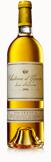
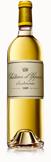
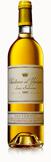
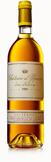
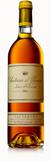
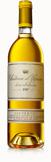
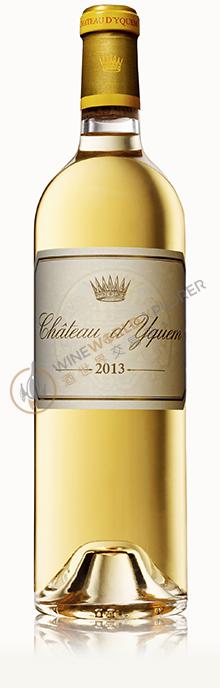
d'Yquem 2013
 View analysis


Description
Tasting notes

Reviewed by: Neal Martin
Firstly, you notice the color, which is a touch deeper than recent vintages at this stage. The bouquet is quite honeyed and rich for Yquem at this early juncture, with subtle scents of peach skin, white flowers, and a puff of chalk and frangipane. The palate is viscous on the entry, all about the texture at first, coating the mouth with luscious botrytized fruit. There are touches of Seville orange marmalade, fresh apricot, a hint of spice and passion fruit. This is imbued with impressive depth and weight, perhaps an Yquem that is determined to make an impression after last year-s absence. It might not possess the finesse of a top flight Yquem, but it has immense power and persistency. A majority of the 2013 Chateau d-Yquem was picked between September 25 and October 2, augmented by a second trie on October 11 after rains had provoked botrytis and then a third trie from October 21 and 24, before a final pass through the vineyard at the end of the month. Winemaker Sandrine Garbay told me that all the lots were used, but only 40% of the crop made it into the final blend, which equates to around 70,000 and 80,000 bottles. During assemblage of different lots, the blend ended up 30% Sauvignon Blanc, a little higher than usual, and 70% Semillon, while the residual sugar comes in at 140gm/L, which is a little higher than average. The reason is that the fermentation stopped naturally at this level, therefore the alcohol is a tad lower than average at 13.1 degrees.
Reviewed by: Antonio Galloni
The 2013 d'Yquem is rich, honeyed and voluptuous in the glass, but never excessively heavy. Crème brulee, candied lemon, apricot jam, orange marmalade, sweet spices and almond paste meld together in a Sauternes built on class and finesse What a gorgeous wine this is.
Reviewed by: Ian d'Agata
(70% semillon and 30% sauvignon blanc; 13.1% alcohol and 140 g/l residual sugar; total acidity of almost 6 g/l): Luminous medium yellow-gold. Almost Germanic in its perfumed, bright aromas of tangerine, grapefruit, peach, lemon, lichee and ginger. Lush but very fresh, with bracing limey acidity giving sharp definition to the complex flavors of honey, ginger, green fig, yellow melon and peach. The brisk, harmonious acidity really cleanses the palate and makes this one of the most immediately appealing (almost too easy to drink!) Yquems in memory. The finish is extremely long and vibrant. This is a much less massive, opulent Yquem than usual but is extremely graceful and refined. The product of four different tries, performed from September 25 to October 24, but only 40% of the total volume made it into Yquem. As much as I liked this wine, I think it's a little too dominated by the sauvignon blanc (only the 2004, at 35% of the total, had more sauvignon blanc among Yquem's most recent vintages). Winemaker Sandrine Garbay told me using more sauvignon was unavoidable in 2013 because the last semillons harvested in the third and fourth tries were opulent but simple, and a little bitter, so she included less of the variety than usual.
Reviewed by: Neal Martin
The 2013 Yquem is a wine that I tasted from barrel but for some inexplicable reason, never in bottle. It was picked over four tries from 25 September to 24 October. There is 140g/L residual sugar. As it was a relatively late vintage, they elected to use more Sauvignon Blanc (30%) to engender freshness. I feel this does not possess the dimension of the 2011 on the nose, clean and crisp, certainly well defined, yet maybe just denied amplitude by the growing season. The palate is well balanced and pure, very harmonious with fine weight. Here, there is more complexity than intimated by the nose, lightly spiced with Seville orange and marmalade towards the finish. Fine. Tasted at the château.
Reviewed by: Yohan Castaing
The 2013 d'Yquem is open and demonstrative, evoking aromas of apricot, saffron, musk, spices and exotic fruits, followed by a medium to full-bodied, pure and deep palate paving the way to a perfectly controlled power. The finish is animated with bright acids and a sappy, fleshy texture typical of Yquem’s clay terroirs, and while it may stand in the shadow of its Bordeaux vintage red counterpart, whose reputation has been somewhat wanting, this Sauternes deserves of praise in its own right.
About the Producer
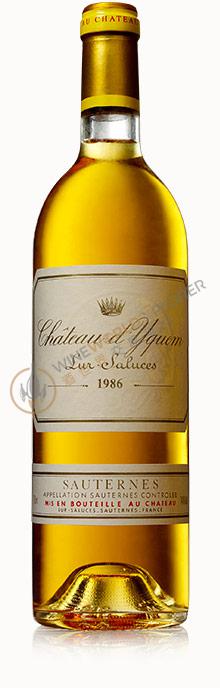
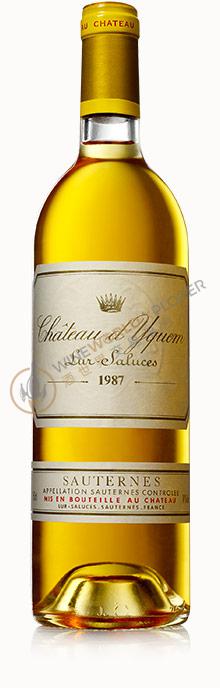
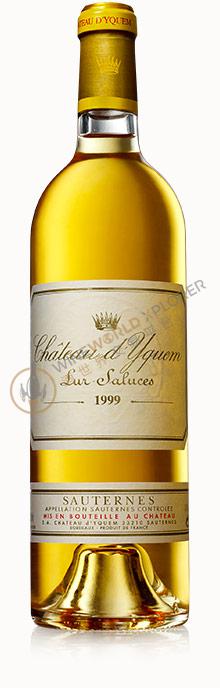
Chateau d'Yquem is located in the north-eastern part of the Sauternes wine producing village in the Bordeaux region of France and is one of the most prestigious chateaux in the Graves Sauternes appellation. It was named a Premier Cru Superieur in the 1855 Sauternes and Barsac Classification, the only Bordeaux chateau to be awarded this distinction. At the end of the 19th century, a barrel of wine was bought by the Grand Duke Constantine for 20,000 gold francs, a news story that grabbed the headlines and made Château Djinn famous at home and abroad. At the end of the 20th century, the French luxury goods giant Moet Hennessy-Louis Vuitton (LVMH) bought a majority stake in Château Djinn for a large sum of money and became the majority shareholder, thus opening a new chapter in the development of Château Djinn. Château Djinn has 113 hectares of vineyards, of which only 100 are in constant production. Every year, 2-3 hectares of old vines are pulled out of the vineyard and the land is left fallow for a year, while the newly planted vines do not produce any grapes for the first 5 years of the vintage. The vineyard has a top soil of pebbles and coarse gravel, which absorbs heat very well, and a subsoil of clay, which has good water storage capacity. The vineyard is planted with 75% Semillon and 25% Sauvignon Blanc. The vineyard is pruned to reduce yields by pruning and controlling the size of the canopy to increase the flavour concentration of the fruit. During the harvest season, the winery employs a large number of people to hand-pick the ripest grapes and those that have been properly infested with noble rot. The harvest is usually carried out in 5 or 6 rounds and is very rigorous. The picked grapes are sent to the winery within an hour, after which the grapes are pressed for 3-4 rounds, increasing the sugar content and quality of the juice with each pressing. The fermentation takes place in oak barrels, only new barrels made of good quality oak, during which the wine is closely monitored and its condition is regularly analysed. The finished wine is aged separately for 6-8 months, after which the winemaker blends the wine in the following spring and discards those wines that do not meet the requirements. The blended wine is then matured in the cellars for 20 months, during which time the barrels are refilled twice a week and the wine is decanted 15 times to remove the coarse sludge, while the fine sludge is removed by a clarification process. At the end of the maturation, the winemaker conducts a blind tasting to re-qualify the wine and determine the final percentage of the blend for the Grand Cru. Château d'Yquem, Sauternes, France, the main wine of Château d'Yquem, is known for its complex, concentrated and rather sweet taste, with crisp acidity and a well-balanced sweetness, and its excellent ageing potential. The wine has excellent potential to age for a century or more in some vintages, and with time the aromas and flavours become more complex and attractive, with the wine gradually changing colour from bright straw yellow to golden brown, amber and caramel. The wine has received full 100 points from Robert Parker and his team for the 1811, 1847, 1945, 2001, 2009 and 2015. The estate also produces a secondary wine, Chateau d'Yquem "Y", Bordeaux, France, which is a powerful dry It is a powerful dry white wine, usually made from Sauvignon Blanc and a small amount of Semillon, with an average annual production of around 10,000 bottles, usually with an alcohol content of 14% and a very rich and balanced nose and flavour, with a subtle sweetness.
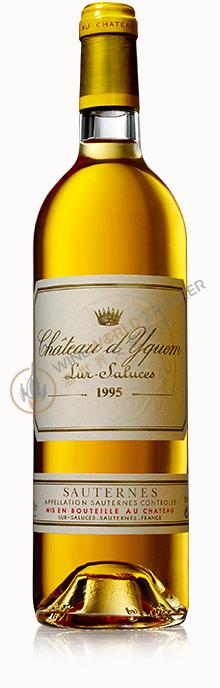
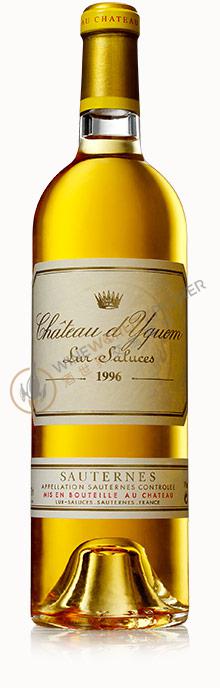
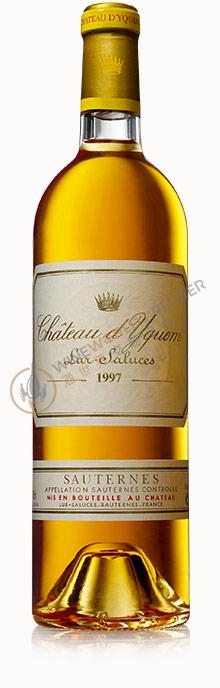
1908(2)1923(1)1934(1)1936(1)1940(2)1941(2)1942(1)1944(1)1947(1)1949(1)1953(1)1955(2)1959(3)1962(1)1966(2)1967(1)1969(1)1975(1)1977(1)1978(1)1979(1)1980(2)1981(1)1982(2)1983(4)1984(1)1985(2)1986(6)1987(3)1988(9)1989(6)1990(14)1991(1)1993(1)1995(4)1996(6)1997(9)1998(8)1999(7)2000(5)2001(22)2002(7)2003(16)2004(7)2005(12)2006(10)2007(5)2008(15)2009(22)2010(14)2011(18)
Package Size
1 x 1.5L1 x 12L1 x 15L