
 Wine Advisor



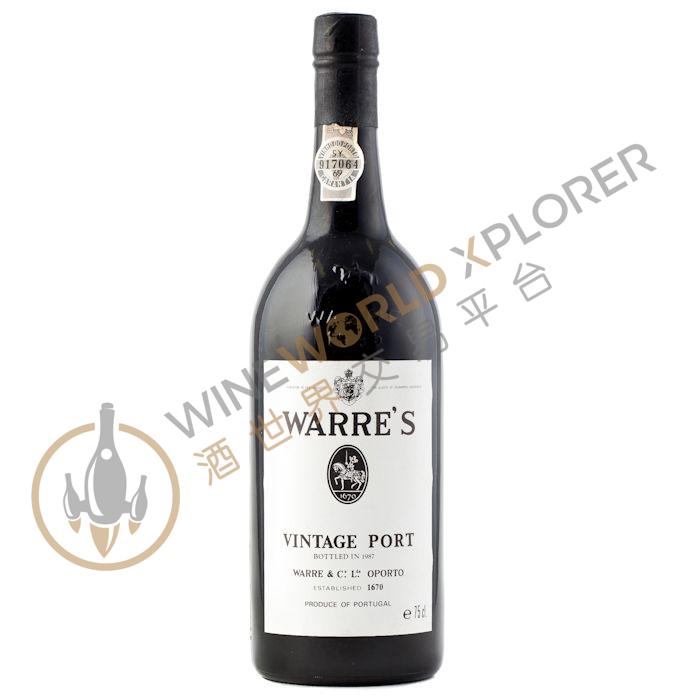
Warre's, Vintage Port 2017
 View analysis


Description
Tasting notes

Reviewed by: Mark Squires
The 2017 Vintage Port is mostly a field blend from old vines (63%), plus 22% Touriga Nacional and 15% Touriga Franca, bottled about a month before this tasting after 18 months in seasoned vats. The just-bottled sample was not actually used for fear it might be in shock, so this is actually a pre-bottling sample. It comes in with 110 grams of residual sugar. Relatively accessible, this still shows some impressive firmness to go with its fine concentration. An elegant wine this may be, as Charles Symington called it, but it is still admirable for its structure, even if the whole package is a little understated. Its fruit and mid-palate are nicely supported by moderate tannins. It evolves well with air, easily showing vivid and fresh fruit. It is beautifully textured as well. This is a fine Warre's Port, holding its own next to Dow, better than the 2016 Warre and a force in its own right. It is one of the best in a while. It is relatively accessible but not ready. There were 3,600 cases produced.
About the Producer
Founded in 1670, Warre’s is the oldest British Port company established in Portugal. Its is the history of two families: the Warres and the Symingtons.The first Warre, William, arrived in Portugal in 1729 and became a partner in the export company Messrs. Clark, Thornton & Warre, which exported Portuguese wine among other goods. By the 18th century, Warre’s had become one of the leading companies in the Port trade. The Symington family joined Warre & Co in 1905 and in 1908 became the soul owners. The Symington family, now 5th generation Port producers, have managed Warre’s for over 100 years and continue to drive it forwards today. Currently six members of the Symington family are actively involved in Warre’s day-to-day management, with the dedication and long-term commitment that are unique to a family-run business. For 350 years Warre’s has been a pioneer in the Port trade, from advances in the winery to viticultural research. Sourced from three vineyards – Quinta da Cavadinha, Quinta do Retiro Antigo, and Quinta da Telhada – the majority of the Port produced is made with modern methods, using state-of-the-art vinification technology, however a small proportion is still produced by the time-honored method of treading.
