
 Wine Advisor



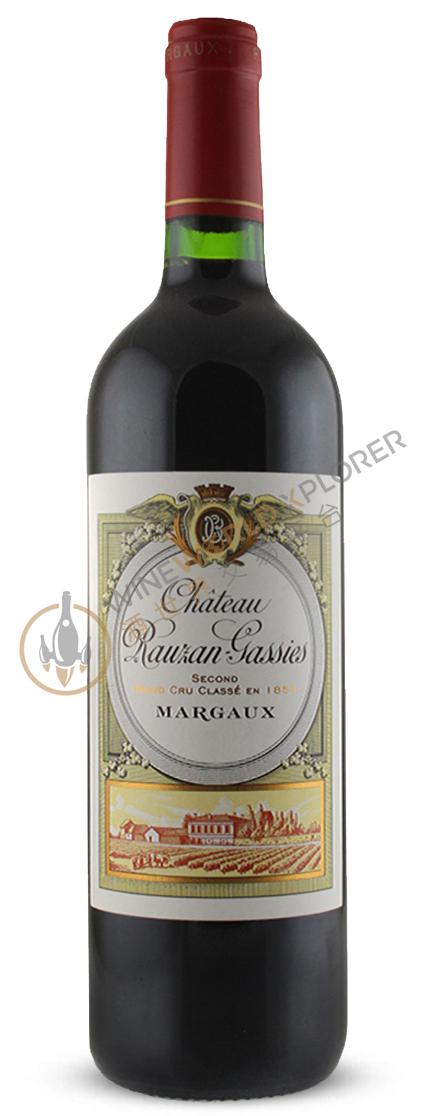
Rauzan Gassies 2014
 View analysis


Description
Tasting notes

Reviewed by: Antonio Galloni
The 2014 Rauzan Gassies is an attractive, supple wine. Sweet floral, underbrush and leather notes add nuance to the bright red-toned fruit. A hint of gaminess gives the wine its slightly rustic feel, but the tannins have softened a bit. My impression is that there is considerable potential at this property that has yet to be fully realized. The 2014 is certainly a very good wine, but it could have been more than that. Tasted two times.
Reviewed by: Neal Martin
The 2014 Rauzan-Gassies has a scented bouquet that does not feel as natural as its peers. The palate is medium-bodied with slightly chewy tannin, fleshy in the mouth with a cedar and white pepper infused finish that feels quite Pauillac in style. But I would have liked more substance and complexity on the finish. Tasted blind at the annual Southwold tasting.
Reviewed by: Neal Martin
The Château Rauzan Gassies 2014 has a modest nose, a little conservative at first with forward sous-bois and tobacco aromas, those dusky black fruit emerging with aeration but never quite getting out of second gear. The palate is actually better than the aromatics with well-judged acidity and a harmonious, quite elegant mid-palate. It finished with commendable precision, though it does not possess the sustain of some of the top performing Margaux '14s. Still, this is a decent Rauzan Gassies that should drink well for a dozen or so years, possibly longer.
Reviewed by: Neal Martin
The 2014 Rauzan-Gassies has a light grassy bouquet, plenty of undergrowth aromas as usual, though missing the fruité of its peers. The palate is medium-bodied with chewy tannin on the entry, a little angular in the mouth with some hardness on the finish. It is a frustrating wine, grasping for quality but not quite getting there. Tasted twice with consistent notes.
Reviewed by: Antonio Galloni
The 2014 Rauzan Gassies has a respectable nose with a mixture of red and black fruit, sage and leather. It's a little Rhône-like in style as it becomes animally with aeration. The palate is medium-bodied with simple but fresh red fruit, orange rind and sage. Quite finessed towards the finish, this Rauzan Gassies is showing much better than expected. A "useful" Margaux. Tasted non-blind at the Southwold 10-Year-On tasting.
About the Producer
Chateau Rauzan-Gassies, located in the Margaux region of France, is one of the most prestigious French wines. The classic elegance of its wines, which have been cultivated over the past hundred years, has allowed Rauzan-Gassies to maintain not only its excellence, but also its aristocratic style. In recent years, Chateau Rauzan-Gassies has received high ratings in wine magazines such as Wine Spectator and Decanter, making it a true wine aristocrat. The history of Château de Rauzan began with the Rauzan family, when Pierre des Mesures de Rauzan bought a large territory near Cantenac in 1661, planted grapes on this marshy land and established Château de Rauzan. Mr Rauzan then travelled to England to sell his wines, which led to an increasing share of the English market for the wines produced by Château Rauzan. The opening of a market in London by Jean Rauzan, a descendant of Rauzan, also accelerated Rauzan's entry into the overseas market. It is said that Jean Rauzan, then a prominent member of Parliament, booked a boat, filled it with wine, sailed confidently to London, docked on the banks of the Thames and began selling wine everywhere. However, to his dismay, the locals did not want to buy his wine. So he opened the bottle and poured the first batch into the river, and after several batches, the boatmen finally started to buy the wine because they didn't want to see such a good wine being fed to the fish. From then on, the wines of Château Ruchen became so popular with the English public that they were in short supply. Under the management of the Ruchen family, the estate was well run and of such quality that Thomas Jefferson bought a few bottles of the estate's wine when he visited France in 1787. Unfortunately, the estate was passed down from generation to generation and was "divided" into three parts due to various marriages. The present day Château Lucerne is also a division of Château Ruchen, a testament to the marriage between the Ruchen and Gassies families, from which the estate takes its name. After its independence from Château Rauzan-Gassies, it continued to produce wines of outstanding quality and was classified as a second growth in the 1855 Médoc classification. The estate changed hands several times until 1968, when Jean-Michel Quie took charge of the estate. Franoise and Jean-Philippe Quie joined the team building the estate. Chateau Rauzan-Gassies has 28.5 hectares of vineyards on a mixture of deep gravel, sandy gravel and sandy soils. The vines are planted with 65% Cabernet Sauvignon, 25% Merlot, 5% Cabernet Franc and 5% Petit Verdot, with an average vine age of 35 years, a planting density of 10,000 vines/ha and an average yield of 4,000-5, The average yield is between 4,000 and 5,000 litres per hectare. Cultivation methods include digging in the winter to improve drainage and promote root growth, natural improvement, pruning, double-armed Guyot pruning and root protection to increase the average vine life and to further control yields. In spring, the vines are thinned (by removing the lesser buds), the excess branches around the end of the vine are removed, the leaves are cut (by hand or by machine) and the fruit is thinned. Chateau Rauzan-Gassies is a full-bodied, rich and powerful wine, with a delicate and aromatic character that distinguishes it from the usual Margaux wines. In most vintages, Chateau Rauzan-Gassies matures at an astonishing rate, often reaching its peak in just 10 years. In the best vintages, the wines of Chateau Rauzan-Gassies can even age for more than half a century.
1923(1)1959(1)1970(2)1971(1)1973(1)1982(3)1983(1)1986(1)1990(1)1993(1)1995(1)1996(2)1997(1)2000(2)2005(3)2006(1)2009(5)2010(4)2011(3)2012(2)2013(1)
Package Size
